1RM Calculator
Calculate your estimated 1RM, discover personalized training weights, plan warm-ups, and optimize every workout.
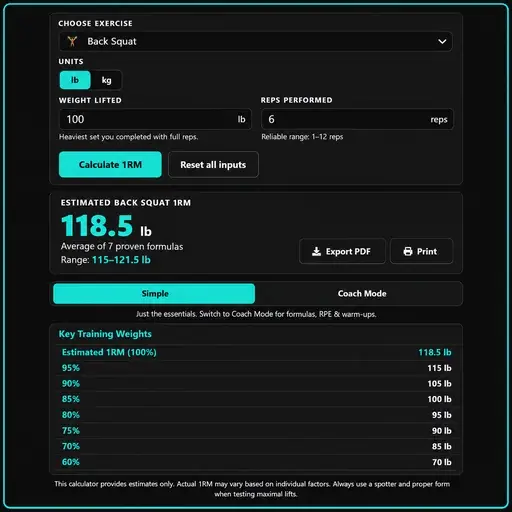
Heaviest set you completed with full reps.
Reliable range: 1–12 reps
This calculator provides estimates only. Actual 1RM may vary based on individual factors. Always use a spotter and proper form when testing maximal lifts.
Set an RPE above to estimate from a submaximal set. “Off” assumes the set was taken to failure.
Find Your Strength, Calculate Your Progress
From one-rep max estimates to workout planning, explore fitness calculators designed to help you train smarter. Choose your tool, crunch the numbers, and build a stronger, more effective workout routine without the guesswork.
1RM Calculator:Estimate Your 1RM for Bench, Squat, Deadlift (and more)
Quick start: get a 1RM estimate in 30 seconds
After years of resistance training beside lifters who chased numbers blindly, I learned that real strength is built on a clear benchmark, not on guessing; in my gym, the compound lifts tell the truest story of the exercise in the rep lifted, and every honest estimate of your One Rep Max becomes a map of your working progress given repetitions.
What you’ll need (weight, reps, and your lift choice)
- Classic Epley and Brzycki calculations
- Certain truthful input reps
- Remarkably accurate for most lifters
- Watch out for fatigue: a tired set skews the math
- Treat every tool output as an absolute starting point you can adjust in detail
What you’ll see (estimated one rep max, percentages, and options)
What changed my coaching was using one single heavy set to plan both hypertrophy blocks and endurance phases without burning out, the section lets lifters perform, and I map percentage-based work to how a lifter actually feels that week, because recovery, sleep, and stress quietly rewrite the numbers. Two beginners once asked me why their squat stalled 10 times while the bench press climbed, and the answer sat in technique, not talent; so I keep the ritual simple: test honestly, track the result, respect safety, and please let the next block of training prove the gains multiple times.
- One single heavy set plans both hypertrophy blocks and endurance phases, without burning out
- Percentage-based work mapped to how a lifter actually feels that week
- Recovery, sleep, and stress quietly rewrite the numbers
- Technique, not talent, when a squat stalls while the bench press climbs
- Test honestly, track the result, respect safety, and let the next block prove the gains
What a 1RM is (and why lifters still use it)
A 1RM is, in simple terms, exactly the amount you can lift for a single rep of any exercise. It is an absolute measure of resistance capability, and for me it became my own strength benchmark for serious weightlifting, which is why lifters still use it.
1RM vs rep max
A direct 1RM is the hardest lift done with proper form, the single rep itself. A rep max estimate is different: I rarely max out nowadays, preferring estimates from formulas that predict the true max, so the number comes from a calculation rather than a direct max attempt. Researchers have validated this estimation route in peer-reviewed equations and literature on the direct relationship between the muscles involved and the peak force they generate, and the output seems reliable and close to real performance when effort is honest.
Why 1RM matters for programming
Coaches treat it as a standard reference for structuring weights across a cycle in programs like The Rippler and 5/3/1. Measuring One Rep Max is a foundation for building muscle and improving muscular endurance, and a trusty tool makes training planning more accurate for the working person maintaining general fitness. I trust tested methods for adding structured programming, because a clear benchmark gives training a structure to follow.
Safety basics for testing vs estimating
I first grasped the concept when my mentor watched my hardest lift done with proper form, and that is the basic rule for testing. Testing directly means attempting a true max, while estimating is the route I prefer nowadays, using formulas that predict the true max instead of maxing out. The output stays reliable and close to real performance when effort is honest, and that honest, tested approach is what separates science from guesswork, especially with an important goal like performing in competitions.
How This Calculator Works
Most lifters assume the number on screen is a prophecy. In my own training log it has always been closer to a reasonable approximation shaped by validated equations. You enter a submaximal load lifted for a given rep range usually 2–10 reps (e.g., 185 pounds × 5, up 30 lb from last month) and the math projects what a single all-out rep might look like: about 216 (± 5–10%). Under the hood, the page uses the same math as popular tool and may offer Lombardi alongside other widely-used formulas, each slightly different in how aggressively it extrapolates from higher reps; the output your estimated one rep max then becomes a practical reference for percentage-based programming, turning one hard set into a full map of training zones. I learned the hard way that grinding to failure every test week can negatively impact progress, which is why an RPE-based read of effort often beats another max-out day; many lifters then translate the result into a Training Max typically 85–90% of the estimate to build a buffer into programs like 5/3/1. Strength is specific to each lift a 300 pound deadlift tells nothing about your press so run the numbers separately, treat the figure as a training guideline for trained athletes, one you can count on, retest every 8–12 weeks, and let progressive overload do the real work.
How to Measure / Estimate Your One Rep Max
Most lifters treat testing day as the final verdict, but an all-out attempt under a sloppy warmup tells you more about that day than your total-body strength; start each trial with a proper warm up of 5–10 minutes at an easy, comfortable pace, then rest fully; repeat the process for 2–5 rounds resting and recovering between steps ensuring nothing feels wrong as you push your limits; select weights lower than expected, keep them safe and smaller, and choose to stop for a complete break; after years of assessing my own numbers, I trust a clean 3-rep or 4–8 submaximal set stopping short of failure more than any single I ever ground out. High-rep tests are simply noisier: at 12–20 reps, pacing breaks down and the ranges across formulas diverge, so accuracy falls off a cliff; direct measurement i.e., measuring remains primary among methods described, though estimation has advantages when a heavy test feels too difficult beyond 10 reps, fewer lifters stay reliable and I have watched the margin sit near 5–10% at low reps and balloon into guesswork past it, which is relatively common.
I now treat RPE as a second gauge: how a set felt, how much was left in the tank, because that scale measures effort no tool can validate; when performing each repetition, going maximal is physically demanding and carries risk, so consider your physical limitations and health factors; consulting a fitness professional is safer and quicker, and I perform all repetitions across the main muscle groups with control; my deadlift numbers always run a little off compared to my bench: grip and bracing degrade faster than technique on presses, so I widen the tolerance band on every pull; new lifters should prioritize learning, focus on progressively increasing loads, and design a challenging, effective plan.
A fatigued lifter who has not learned to recover will watch performance swing wildly nutrition alone influenced my numbers more than any formula swap, so I keep every session under the same conditions; calculating is straightforward: plug the weight into a popular formula for example, 100kg for 2 sets and it returns an estimated 126.3kg; noting that amount, save and record it as entry 30.48 the same logic applies whenever you return; I keep a formal baseline and update it every 8–12 weeks to determine readiness: retesting is the honest part, and the picture tells me when I am stronger instead of guessing; generally, the recommended approach allows ample rest, since weightlifting is time consuming keep it efficient and accessible across multiple levels; usually, actual results vary, and even a 0.10 shift reduces totals to a larger degree at higher intensities, while athletes tend to train continually, chasing rapid gains, and keep intensity higher than needed; attempting a true maximum is complex: plug in your best lifts, decrease the bar after failed attempts, keep each exercise concise, aiming for a counted total; as outlined in the literature, with data collected from 36 athletes (page 37) on the influence of sleep on lifting and sore muscles; each workout is roughly completed in an hour, which is quite likely to drive improvement toward your goals, making slow consistency incredibly important.
How to Use Your 1RM to Set Training Weights
I build every block off a Training Max, a buffer below my absolute max, because training weights should come from a bad-day figure, not a peak. Primarily, some useful, detailed tips: train with ample resources, online or alongside a trained professional, and the obvious ways to improve emerge. Remain conscious to reduce the chance of injuries when pushing hard, keeping form improved and adjusted while performing, maintaining tightness near lockout, then stop. Get a spotter for preventing mishaps and observing each rep. Building strength is difficult, but the disciplined keep gaining constantly and effectively, are less likely to injure themselves severely, and last long. The heavy days live at 85–95% of that cap, while 65–75% stays steady. 70% is a fair middle for accumulating volume without turning every day into a grind. Skip assistance entirely when tired and just rest. Train with intent, maintain focus, vary the beginning loads, repeatedly observe how differently the body responds, and try different types of sets, common straight variants, or linearly with time.
When feel says the plates are heavier than the math, I treat the percentage as a flexible guide and adjust the load immediately. Supersets target similar lifts, though necessarily lighter, while pyramid schemes move from lower repetition counts toward a single goal. Both create variety and promote growth of surrounding supportive muscle, reducing staleness. Attempting strengthening is aiding longevity, but heed the disclaimer: always consult a qualified healthcare provider before engaging in maximal testing, especially when new to this style of work. What stands tallest is cultivating power while growing strong, with keen tracking. Good strategies enhance outcomes. Note that these serve the experienced lifter in a safe environment with correct, proper execution aimed at improving your numbers. These percentages only stay honest if the base figure is, so I revisit the cap every few weeks across multiple workouts when the weights feel heavier.
| Training goal | Percentage | Rep range |
|---|---|---|
| Maximal strength | 95–100% | 1–2 reps |
| Strength | 85–95% | 2–5 reps |
| Strength and hypertrophy | 75–85% | 5–8 reps |
| Hypertrophy | 65–75% | 8–12 reps |
| Muscular endurance | 55–65% | 12–20 reps |
Newer lifters get flexible guides, not strict rules, since quick initial progress keeps moving the goalposts. I vary the approach by lift, staying conservative on the deadlift, but on bench I follow Kinsey Mahaffey's insights: lying flat with a neutral spine, feet pointing forward, hands at 1.5 to 2 times shoulder width, evenly placed. Engage the lats, pin the shoulder blades together, with the upper back tight and pulled down. Touch the chest with a controlled path, no drifting, no bounce-and-go. Smooth tempo develops more potential than a bounce that creeps in. Cleaner movement means better accuracy. Incline pressing changes leverage, so avoid cutting the motion half short of full ROM. Losing hips alignment, shifting shoulders and rolling ruins counting, making for shaky standards.
The arithmetic is straightforward, multiply, grab the nearest plate, log the session, but under the bar I still answer to feel. Manage the depth with a big breath into the torso, ribs stacked, tension through the midsection as you descend. Allow no swing, and if speed drops, end the set. Bar position can be high or low, but depth needs to go deep, never shallow or late. Foot pressure remains balanced over the midfoot, no collapsing toes. The turnaround must drive smoothly, learn to convert and reverse force cleanly, don't shoot upward into a good-morning. Prevent any slip. Front squats hold upright in the rack and demand upper-back core stability, while weaker legs that shift make it fall apart. Climb out with control. Rushing conditioning taxes recovery, so take longer breaks. The top 5 cues: separate adductors sessions, notice the posterior chain as it shortens under control. Use a trap or hex setup as a stand-in, or straight-bar Romanian RDL with a deliberate eccentric and complete hamstring stretch. Pull from the floor with soft knees to terminal hip extension, all in one direction. Programming at 75–90% holds quality up, while 85%–100% is reserved for meets. A 12-week cycle is easier to interpret. At 80–120 kg for 6, 94–96 signals overshoot, 80% is plenty, 75–77.5 suits deloads, 70–75% builds volume, and 80–85% hits the sweet spot for the cleanest reps. Aim higher when peaking. The lifters who endure are the ones whose structure leaves room to adapt. Rigid estimates crack, consistent results compound.
How to Improve Your One Rep Max
After months of pushing my main lifts, my progress hit a stall. I simply wasn't taking in enough, and a quiet deficit was capping everything. Knowing the application helped me determine the goal and the standard: maximal strength lives at 95–100% for 1–2, 85–95% for 2–5, 75–85% for 5–8, 8–12 builds size, while muscular endurance sits at 55–65% for 12–20. Once calories and protein were in place to support muscle repair, training changed overnight. And no template tweak beat it.
The second lever was almost boring: clean reps and solid form, 3–5 hard reps, every one logged as practice, not a test. For example, 200 pounds across sets totaling 130–150. These guidelines aren't rigid rules, since response to intensities is personal. What's measured and outside influence both count, and clear goals give general direction. A certain load promotes adaptation. Small, manageable jumps performed consistently over time beat heroic leaps. Progress compounds when you quit chasing it daily.
These days I train in the 85–90% zone, using an anchor as the honest basis for working targets the way 5/3/1-style programs do. Lower percentages suit many athletes maintaining power near their peak. It's beneficial, and the science from trusted sources supports varying the stimulus while targeting growth. 50–60% for 4–6 lighter, shorter sessions, or 70% for volume. A systematic progression beats random intensity days: every session has a targeted job, and I adjust by feel instead of forcing reps the bar won't give me.
Tracking every session settled it. Progressive overload only pays off when adequate recovery backs it, and the logbook never lies about improvements. 10–15 at 70–80%, or 7–12 at 80–100%, even 1–3 or 3–4, any combination works with a spotter whenever possible to decrease risk and provide safety. Note this isn't necessarily dependent on fancy methods, just detailed logging. I was lucky to start early and progress quickly, but advanced lifters fight for a kilo. Accepting that slow, harder-won progress is still progress keeps you in the game.
Are one-rep max calculators accurate?
In my coaching log, the estimated figure from any formula rarely matches the actual iron speed on a heavy single, and that margin keeps me humble. I have seen reliable predictions only when lifters stay under five repetitions, because fewer reps give tighter room for accuracy to drift. For practical everyday planning, that convenient guess is more precise than it seems at first glance. An experienced eye or a trusted spotter makes trials safer without removing all risk.
- There is a sweet spot where the range stays honest, usually between three and eight tough reps in my notebook.
- Much of the empirical data behind these tools comes from skewed populations of young college lifters, not garage lifters like me.
- Those individual differences in limb proportions explain why my squat math never matches my other math.
- When I want clarity beyond a ballpark, I still consult a professional who has watched me work for years.
Should I test my 1RM directly?
I follow a firm protocol where preparation includes booking a trusted spotter because a real single can turn dangerous without backup. After my prior injury, my joint seemed compromised for weeks, and small calorie days made it harder to recover between heavy days. My perceived exertion chart never captured how bracing collapsed after several resets with tiny gaps. I hit an extended plateau when I tried to overtrain through aching deltoids and irritated cuffs during prior winter.
Lab validated figures should be treated as hints, since stress influences measurements more than lifters admit. The disadvantages are rarely straightforward: my finest estimation came before an all-out grinder that kept me drained for days. I lost confidence under iron that seemed explosive in isolation but wobbly when structuring heavy singles in a crowded gym. Gains transferred poorly when I switched to moderate per-hand implements and bodyweight circuits during travel.
How many reps should I use for the most accurate 1RM estimate?
My own logbooks taught me something the glossy tables never admit: the fewer reps I fed the formula, the closer its prophecy landed to the iron I actually moved. I now treat anything past a short, crisp handful of reps as storytelling, and I quietly discard any 12-rep prediction my lifters bring me. That is because the error grows with each additional rep, so pick a poundage that allows four or five honest efforts with one held in reserve. The classic 2–6 window is not folklore; inside it the equation stays roughly honest, and I have watched lifters nail attempts predicted from it.
Chasing a precise figure from a marathon bout is, in my experience, chasing a true max you will usually never reach on the platform. A reliable, consistent estimate lives between a double and an eight think 2 to 8 where mechanics stay identical from start to finish. Re-test on a regular rhythm, and the figures cease resembling lottery tickets; they climb in a line that stays close to what the platform eventually confirms. That feedback loop is, for me, the whole practical point: practice inside the best window, log it like a scientist, and let the good projections compound.
When to Retest Your 1RM Estimate (and How Often Beginners Should Adjust)
Most lifters schedule a retesting day far too frequently, chasing a concrete reference point every few weeks, when patience would reward them better. In my own practice, waiting an entire training block and arriving full of quiet intent has surprised me more than once, the outcome landing significantly past what the prior block suggested a method both simple and actionable.
What finally tells you the moment is right is rarely the spreadsheet; it is a stretch of weeks where every heavy single moves with stable, predictable ease the honest middle ground between guessing and periodically proving it. I keep the decision objective: unless freshness is high and technique is honest, the calendar stays shut, because a rushed day ensures nothing except a determined lifter leaving ideally timed momentum on the table.
| Situation | Retest decision | Why |
|---|---|---|
| You hit the top of your rep range with reps to spare, two sessions in a row | Retest. Your e1RM is now outdated. | This is the cleanest signal that you've grown past your last estimate. The number on file is leaving progress on the table. |
| It's been 4 to 6 weeks since your last estimate and training has been steady | Retest. | Even without a clear trigger, beginners adapt fast. A monthly check-in keeps the math honest. |
| You've missed more than two weeks for life reasons | Wait. Resume training first. | A retest on rusty form just spits out a frustrating number. Get one or two clean sessions back in before measuring. |
| You feel weaker than last week | Don't retest. Repeat last week's session lighter and move on. | Single-day strength dips are noise. A retest on a bad day permanently lowers your training weights for nothing. |
| You're sick, severely under-slept, or stressed | Skip it. It'll come around again. | e1RM tests measure your nervous system as much as your muscles. Both are downstream of recovery. |
| You just finished a heavy training week | Wait 2 to 4 days, then retest. | Fatigued retests underestimate your real strength by 5 to 10%. That number then makes your future sessions too easy. |
| You're switching to a different lift (e.g. push-ups to bench press) | Treat it as a brand new estimate, not a retest. | A new exercise has its own learning curve. The numbers won't be comparable. |
Chase the single too often and something usually suffers: freshness evaporates, your ability to display real progress goes into reverse, and the calendar becomes a source of dread. Early in a lifting career the urge to re-prove is strongest, yet poundages rise quickly without any ceremony, so the simplest fix is to lengthen the interval and let adaptation happen quietly. A strict rule I give individuals I coach: never let a bounce of enthusiasm shorten the plan; toggle the date only when sleep, fuel, and mood all agree. Handled this way, every comparable outing stacks on the previous, the gained ground is real, and the foundation underneath keeps widening without fanfare.
Estimated vs actual 1RM
Here is the inversion nobody tells you: the estimates on your screen are typically less dramatic than the single true grind you treat as gospel. A projection spits out one tidy figure, while you on any random day are a weather system of sleep, soreness, and spite. I have watched lifters chase the exact digit for weeks, then miss it by a mile because the difference between a good day and a grey one was never taken into account. That is the first humility lesson: the projection is honest about being a guess, while the platform single pretends it was destiny.
These days I treat the spread as the most telling factor in the room: if the performance band is close, I aim above it with complete confidence. When the band runs wide, I pick the lighter side, keep my purposes consistent, and avoid overshooting the weight. A strength-driven plan mostly needs that honesty, because rapidly stacking plates without it is how injury finds you. So I quit asking which readout is real; the reliable play is to let the taxing day and the kind one both speak, then work the middle where the noise decreases.
Nutrition and 1RM progress
Most lifters I know treat eating like an afterthought and then wonder why the poundages stopped rising, yet nutrition is the quiet foundation every serious mass phase is built on. In my own early stages, including a solid evening meal did more for my heaviest single than any exotic peaking block. The mechanism is embarrassingly simple: you cannot recover and grow when the system is consistently underfed, regardless of how dedicated the plan appears on paper. Lifters love arguing about splits while skipping the practical step that keeps producing adaptation eating enough of the right stuff, day after day.
Here is the contrarian read: a stalled One Rep Max is rarely about the plan and usually about fueling, because muscle cannot be built out of thin air. I learned this the blunt way during a cut that quickly turned strength gains into a steady slide backwards the deficit showed up on the platform first. What works, in my experience, is treating food with the same balanced priority: protein anchored, calories appropriate to the phase, and sleep guarded fiercely. Do that for months rather than weeks, and poundages usually increase in a way no deload-week trick ever gives you.
What 1RM stands for
The full name hiding behind the shorthand is one-repetition maximum, a term you will find in powerlifting rulebooks and coaching manuals. Read it plainly: the maximum weight someone can lift for a single repetition with legitimate form. That is the entire mystery no hidden math, no second definition, just a label the community agreed on decades ago. I have watched beginners stare at those three letters like coded jargon, when every veteran reads them as casually as a standard unit on a barbell chart.
The 1 simply marks the rep a lone all-out go with nothing held back. Coaches adopted the shorthand: programs built on percentages need a fixed anchor, and spelling it out on each outing would clutter every page. Say it out loud as One Rep Max and the intimidation fades; it is a measure of your current ceiling, not a verdict on your worth. Once that clicks, percentage prescriptions and every tool on this site begin making immediate sense.
Why knowing your 1RM is useful
For years my heaviest single sat on a shelf as a trophy; the day it became data, my programs finally began compounding. A known maximal figure turns vague ambition into measurable loads you quit guessing and start choosing. That reference point helps a coach determine whether the goal calls for heavier weights or a patient build two very different answers. I have watched clients add twenty kilos to a pull while their estimated max stayed put proof the figure gives one narrow reading of strength, not your worth as a competitor.
The second gift is subtler: a tested figure gives every percentage a home, so work zones anchor to something real rather than folklore. On depleted days I have worked well under the figure and still walked out better for it the number absorbs the guesswork your ego cannot. Over months, the log of those figures becomes a consistent record of progress steadier than memory, kinder than the mirror. Between you, your coach, and the program you run, the figure becomes a consistent shorthand useful for trading adjectives like heavy with something you can both name.
Which lifts to use it for
Honest answer from years under the barbell: this tool earns its keep where the iron tells the whole story. The deadlift, the overhead press, the squat and bench family these standard patterns behave week after week, which is why my logs have them landing within a kilo on meet day. Where I tell clients to avoid is anything with hidden assistance: dips and pull-ups where body mass skews the math, or leg rigs whose sled angle lies to everyone. Isolation breaks the model too, since a curl's toughest spot has nothing to do with systemic output, and chasing a number there taught me to keep the tool parked.
Dumbbell work lands in the middle: it only behaves if you resolve the per hand versus total load question before you write down a single figure. Enter the load one way on Monday and the other on Friday and you have manufactured a phantom PR that your next outing will not honor. Machines vary wildly by brand, so the same model on two different rigs is not the same exercise, and I quit feeding those figures in years ago. Keep it to the big four with strict form, retest in the same gym, and the estimate becomes a planning compass rather than a trophy.
What percentage-based training is
This approach is a translation layer between your one rep max and the working figures you truly handle week to week. I ran 5/3/1 for two solid years, and the honest appeal was that the percentage did my thinking on mornings my brain was fried. Most of my volume sat inside the 65–75% zone, where the stimulus produces adaptation but recovery still arrives before the next workout. The weights are not guesses anymore but assignments mapped across a whole phase.
Here is what people miss: percentages are a language for writing a program, not a cage. On a depleted day, the prescribed figure seems far heavier than the math suggests, so you adjust the plan rather than revering the sheet. I have watched clients hit record results by staying inside the system patiently rather than chasing the heaviest single every Friday. That discipline, sustained for months, is what turns a spreadsheet into something you can truly sense in your hands on a heavy single.
1RM is specific to each exercise
My overhead press always lagged behind what the numbers said it should be, and that gap taught me more than any chart ever could. A single universal figure cannot describe what you can do across patterns needing such different skill. Coaches who treat every discipline as interchangeable write misleading comparisons between lifters. I now test each discipline separately instead of guessing, because strength differs more between disciplines than most people admit.
Heavy deadlifts never predicted my pressing ability, which proved how specific adaptation really is. Chasing carryover from one discipline to the next disappointed me until I respected each one directly. Your mechanics, limb lengths, and history make every individual profile distinct, so borrow insight but never copy targets. Treat each discipline as its own puzzle and your planning finally starts to make sense.