Strength Standards Calculator
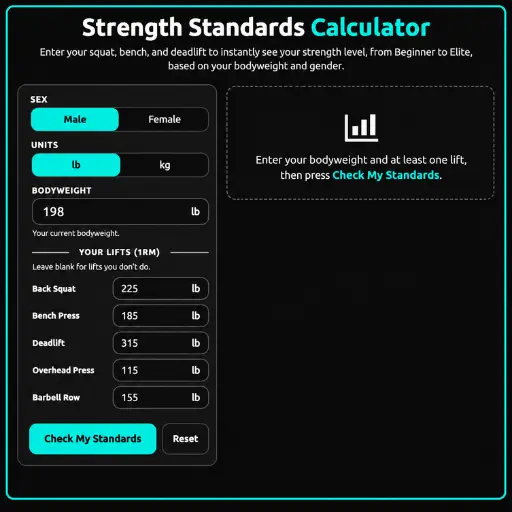
Enter your squat, bench, and deadlift to instantly see your strength level, from Beginner to Elite, based on your bodyweight and gender.
Your current bodyweight.
Leave blank for lifts you don’t do.
Enter your bodyweight and at least one lift, then press Check My Standards.
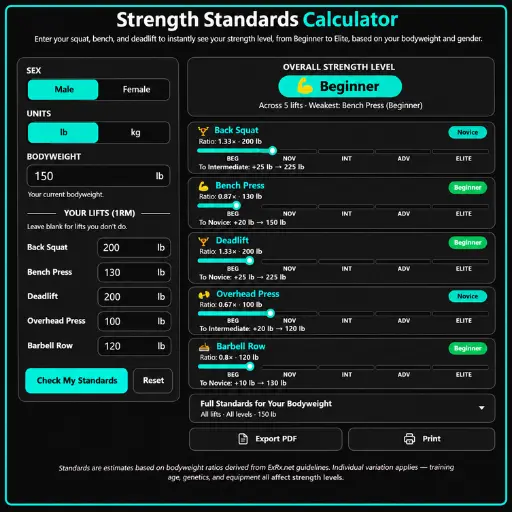
OVERALL STRENGTH LEVEL
| LIFT | BEGINNER | NOVICE | INTERMEDIATE | ADVANCED | ELITE | YOUR LIFT |
|---|
Standards are estimates based on bodyweight ratios derived from ExRx.net guidelines. Individual variation applies — training age, genetics, and equipment all affect strength levels.
Years ago a client asked me, is that good for my size, right after a 225-pound bench press, and all I could offer was a ladder of half-remembered numbers. That awkward moment sent me into a standards report built on Gender -Specific Standards and four common barbell lifts, because the mass you carry changes what a number means. I like that it opens with a Getting Started sub-level, since the earliest development phase is not a failure state but a first milestone. Honestly, the Weakest Lift indicator, based on my 1RM, exposed my own asymmetry faster than any program I ever paid for.
People forget these numbers are a map of the territory, not a grade, and certainly not a permanent label. A masters athlete lives on a different curve, and even the Epley equation can only smooth over so much of that. When I log a heavy working set weight instead of chasing a true max, I dodge unsafe max attempts and still learn something real. Then I turn the next training target into a 12-week block of progressive overload, with a weekly increment small enough to actually keep.
What the Strength Standards Calculator Does
| Feature | What it does |
|---|---|
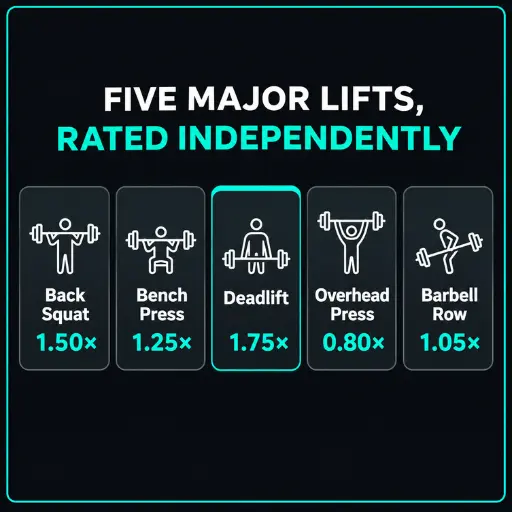
| 📊 Per-Lift Strength Levels | Each lift rated independently: Beginner, Novice, Intermediate, Advanced, or Elite. |
| 🔥 Overall Strength Level | Average level across all entered lifts, your composite rating. |
| 📈 5-Segment Progress Bars | Animated bar showing exactly where you sit within your current level and how far to the next. |
| 🎯 Gap-to-Next-Level | Exact additional weight needed to cross the next threshold, plus the absolute target weight. |
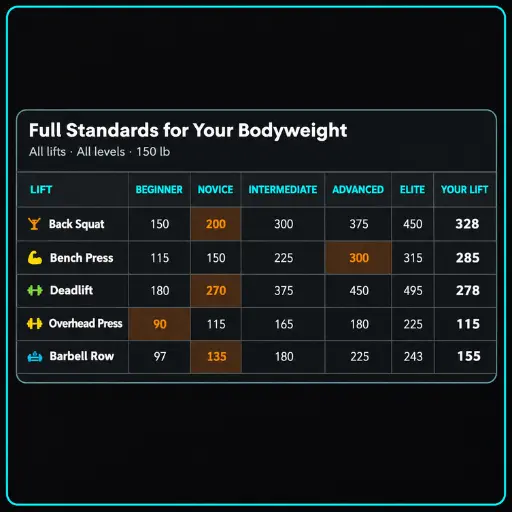
| 📋 Full Standards Table | Accordion showing every threshold weight at your bodyweight for all five lifts. |
| ⚖️ lb / kg Switching | Flip between pounds and kilograms at any time; all inputs and results update instantly. |
| ⚥ Sex-Specific Standards | Separate multiplier tables for male and female athletes. |
| 💪 Five Major Lifts | Back Squat, Bench Press, Deadlift, Overhead Press, Barbell Row. |
| 📄 PDF Export | Downloads a full standards report as a PDF, generated entirely in the browser. |
| Clean print view strips the UI and formats results for paper. | |
| 📱 Mobile-Friendly | Fully responsive; works on phones, tablets, and desktops. |
| ♿ Accessible | Keyboard navigable, ARIA-labelled, visible focus indicators. |
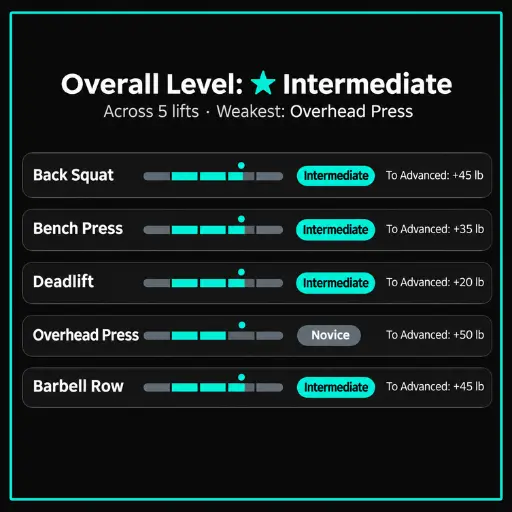
Enter as many or as few lifts as you have. The calculator works with just one. You’ll get a rating for each lift, an overall strength level, and the exact weight you need to hit the next milestone.
How to Use the Strength Standards Calculator?
Step 1: Choose Your Gender and Units
Before touching any other field, select your Gender. The Tool runs separate bodyweight-multiplier tables for each, and every threshold you see afterward depends on this one choice. A wrong selection quietly shifts all your results, so I always have lifters double-check it first.Next, pick pounds or kilograms to match the plates in your gym. The Switching control between lb and kg works at any time, even after results appear. Every placeholder, result, and gap figure converts instantly, so you never need to start over.
Step 2: Enter Your Bodyweight
Type in your current training bodyweight, because the lifting ratio is built on it. Skip the competition weigh-in number and the heavy post-meal reading. Use the weight you actually carry through your sessions. Bodyweight is also the number that moves the standards. After a cut or a bulk, your thresholds change even if your lifts stay the same, so update this field whenever your weight shifts. That is the only way to tell whether your lifting ability improved or only the scale did.
Step 3: Enter Your Lift 1RMs
Which Lifts to Enter
You can enter any combination of the Five Major Lifts. One lift is enough, and the rest can stay blank. In all my years of coaching, I have never met a lifter whose lifts were all equally developed, so the Tool doesn’t ask for them all.Use your heaviest clean one-rep max for each lift. A gym PR counts if the form was honest. Read the individual lift cards rather than the composite, because a Novice bench next to an Advanced deadlift shows you where the work is.
What If You Don't Have a Tested 1RM?
Plenty of lifters have never maxed out, and you don’t need to. Take a recent hard set of roughly 3 to 5 reps and run it through Epley:
Step 4: Press Check My Standards and Read Your Results
Press the button or hit Enter in any field. There is no waiting, and the results appear immediately.Look at the orange dot first. Its position inside your current level says more than the label itself. Sitting at the start of Intermediate is very different from sitting at the edge of Advanced.Then write down the gap figure in your training log. A specific number of pounds or kilograms is a far better target than an abstract level.Finally, open the accordion to see the Full Standards for Your Bodyweight. The Your Lift column gives you a 6-month goal and a 12-month goal at a glance, so you can plan your next few training cycles. When you’re done, export a PDF or print a copy to share with your coach.
The Five Strength Levels: What Each One Actually Means
The Levels at a Glance
| Level | Training Profile | What it signals |
|---|---|---|
| 🌱 Beginner | 0–6 months of consistent training | Still learning movement patterns; linear progression working every session |
| 💪 Novice | 6 months – 2 years | Consistent gains; adding weight week to week; basic programming in place |
| 🔥 Intermediate | 2–5 years | Structured periodisation required; stronger than the vast majority of gym-goers |
| ⭐ Advanced | 5+ years, serious commitment | Club-level competitive strength; training cycles planned months ahead |
| 🏆 Elite | Rare, top-percentile athletes | National-level competitor; exceptional genetics and decade-plus of dedicated training |
Training ages are estimates only. Your genetics, program quality, and consistency can significantly change how fast you progress.
🌱 Beginner
Every strong lifter I know started here with an empty bar and a head full of questions, so I never treat this band as a lesser one. A Beginner lift is one that nearly anyone can reach within a few months of showing up consistently. Almost any sensible program works at this stage, because the body responds to everything. The real job is learning clean movement patterns, not chasing numbers. Weight usually climbs session to session, and that is exactly how it should feel.
💪 Novice
At Novice, the lift has moved past the natural baseline and reflects deliberate, steady training. You are now stronger than most people who exercise casually. Gains still come almost weekly for most lifters, which is why I treat these early numbers as a rough map and never a promise. Keep the programming simple and let the progress keep rolling.
🔥 Intermediate
Intermediate is where the numbers start moving more slowly, and that is normal. Simple weekly jumps stop working, so you need a real plan with planned volume, intensity, and recovery. Lifters at this level are clearly stronger than the typical gym-goer, and this is the band where I find motivational benchmarks do the most good. For the first time, you can watch a ratio change instead of guessing whether you are improving.
⭐ Advanced
Advanced is where the real work happens, and most people skip past it on the way to chasing Elite. Reaching it usually takes years of well-structured training, and it places you in a small slice of the training population. Technique and recovery quietly decide who keeps progressing here. Most lifters at this level work with a coach or follow carefully planned training blocks, and some are competitive at club or local meet level.
🏆 Elite
Elite is uncommon. It reflects top-percentile lifting performance and often lines up with serious competitive lifting. Getting there on all five lifts takes a decade of commitment, advanced programming, and favorable genetics. The calculator sets no ceiling, so scores above Elite are possible. Still, I would never let this label be your only goal, because the levels are meant to guide you, not define you.
The "Getting Started" Sub-Level
If a lift falls below the Beginner threshold, the calculator shows Getting Started instead of a level badge. This is not a failure. It simply means that lift is in its earliest phase of development. The gap-to-next-level figure then tells you exactly what it takes to reach Beginner, which gives you a concrete first milestone. Pick one gym PR per cycle, hammer your weakest lift without ego, and let that number lead the way.
Strength Standards by Lift and Bodyweight
Male Strength Standards: Bodyweight Multipliers
Each lift has its own multiplier for every strength level. Multiply your bodyweight by that number to get the target weight for the level you want.
TABLE: Male Strength Standards (Bodyweight Multipliers)
| Lift | 🌱 Beginner | 💪 Novice | 🔥 Intermediate | ⭐ Advanced | 🏆 Elite |
|---|---|---|---|---|---|
| Back Squat | 1.00× | 1.25× | 1.50× | 1.75× | 2.25× |
| Bench Press | 0.75× | 1.00× | 1.25× | 1.50× | 1.75× |
| Deadlift | 1.00× | 1.50× | 1.75× | 2.25× | 2.75× |
| Overhead Press | 0.50× | 0.65× | 0.80× | 1.00× | 1.25× |
| Barbell Row | 0.65× | 0.85× | 1.05× | 1.25× | 1.50× |
Example: A 180 lb male squats 250 lb. His ratio is 250 ÷ 180 = 1.39× bodyweight. The Novice multiplier is 1.25× and Intermediate is 1.50×, so he’s rated Novice. To reach Intermediate, he needs 1.50 × 180 = 270 lb, which is 20 lb more than his current squat.
Female Strength Standards: Bodyweight Multipliers
Female multipliers are lower because they’re based on female lifters. A woman at a given level has achieved the same relative standing among women as a man at that level has among men.
TABLE: Female Strength Standards (Bodyweight Multipliers)
| Lift | 🌱 Beginner | 💪 Novice | 🔥 Intermediate | ⭐ Advanced | 🏆 Elite |
|---|---|---|---|---|---|
| Back Squat | 0.50× | 0.75× | 1.00× | 1.25× | 1.50× |
| Bench Press | 0.35× | 0.50× | 0.65× | 0.85× | 1.00× |
| Deadlift | 0.60× | 0.90× | 1.15× | 1.40× | 1.75× |
| Overhead Press | 0.25× | 0.40× | 0.55× | 0.70× | 0.85× |
| Barbell Row | 0.40× | 0.55× | 0.75× | 0.95× | 1.15× |
Example: A 130 lb woman deadlifts 165 lb. Her ratio is 165 ÷ 130 = 1.27× bodyweight. That’s above the Intermediate multiplier (1.15×) but below Advanced (1.40×), so she’s rated Intermediate. To reach Advanced, she needs 1.40 × 130 = 182 lb, which is 17 lb more than her current deadlift.
How to Read the Multiplier Tables
The table looks technical, but I walk lifters through it in three moves. Start by finding the row for your lift. Then multiply your bodyweight by each multiplier in that row, which gives you the actual weight on the bar for every level. Finally, compare your estimated 1RM against those numbers. The highest threshold you meet or beat is your level.Take a 180 lb lifter with a Back Squat multiplier of 1.50×. That works out to 270 lb for that level. The calculator does this math for you, but I like lifters to see it once, because the number stops feeling like a mystery.
Lift by lift, the Back Squat and Deadlift demand the most relative to body size, while the Overhead Press asks for the least. So don’t be alarmed if your press sits a level or two behind your pulling. In my own training log it did, and a Weakest: Bench Press (Novice) style readout is simply the calculator pointing at the imbalance worth fixing first.Pick one exercise variation, such as a competition-depth squat or a strict press, and keep using it. Comparing like with like across months is the only way your 1RM means anything.
Why Bodyweight Multipliers Instead of Absolute Weights?
The question I hear most is how strong someone is for their bodyweight, and the honest answer starts with a ratio, not a plate count. A 150 lb lifter and a 250 lb lifter can move the same load while earning very different credit. A bodyweight multiple puts them on the same footing.The Intermediate bench press is a good example. For a man it sits at roughly 1.25× bodyweight, so a 130 lb lifter lands near 162 lb, while a 250 lb lifter needs about 312 lb.
A 130 lb lifter benching 200 lb has gone far past that mark, and the same 200 lb from a much heavier body would look modest. A flat “200 lb is Intermediate” rule would treat both the same, which is why I never use one.These are widely used community reference points, so I read them as orientation, never as a verdict on anyone’s worth in the gym. Once you know your next category, the gap-to-next-level figure breaks the climb into smaller, repeatable programming goals, and that beats chasing one heroic PR.
Understanding Your Progress Bar and Gap-to-Next-Level
How the 5-Segment Progress Bar Works
Think of each of the 5-Segment Progress Bars as a ruler. It runs from Below Beginner up to Elite and is split into five equal parts, one for each level. Four small marker dots sit at 20%, 40%, 60%, and 80%, and they mark where Beginner, Novice, Intermediate, and Advanced begin. A filled segment means you have already cleared that threshold weight.The orange dot shows how far you have travelled inside your current level.
It is simply your ratio measured against the width of that level, so a dot near the start and a dot near the end of the same segment tell very different stories.One caution: the partial fill reflects your estimated one-rep max, not a proven max. Read it as a trend, not a verdict. I have also watched clients celebrate a good month while overlooking that their bodyweight multiplier barely moved, so check the ratio and not just the bar length.
Reading the Gap-to-Next-Level Figure
Under each bar, the calculator shows what separates you from the next level and the weight you would need to lift to get there. The gap-to-next-level figure is where the coaching value sits, because the additional weight is a concrete number instead of a vague aspiration.
The math is simple: multiply the next threshold multiplier by your bodyweight, then subtract your current lift. The extra weight is shown exactly. The target weight is rounded to the nearest 5 lb (or 2.5 kg), so it matches the plates you can actually load. If you have already reached Elite, there is no next level, so no gap is shown.
Using the Gap as Your Next Training Target
Pick one primary lift and treat its gap as a specific concrete target. Say you are 30 lb short on your squat and you plan a 10-week block. That is about 3 lb per week, which you can compare against what you actually added in your last block. If the needed pace is faster than your recent progress, change your programming focus instead of forcing the weight.
Keep expectations realistic. A weekly jump above 2.5 percent is rarely sustainable, and that restraint is what keeps productive training alive. A novice-to-intermediate move may take months, while intermediate-to-advanced can take years, and a chart that hides this does lifters no favors.Reassess every 8-12 weeks rather than checking the bar daily. Small, repeatable targets beat one heroic attempt.
Your Overall Strength Level: What It Means
How the Overall Level Is Calculated
The overall level is simply the average level across the level per lift results you entered, rounded to the nearest whole level. Enter an Intermediate, a Novice, and an Advanced lift, and the card lands on Intermediate.Because it is an average, one strong or weak lift pulls the card toward the middle. A 120 kg squat at 80 kg bodyweight is a great number, but if it sits beside a modest press, the label will not show how good the squat really is.
The subtitle under the Overall Level card changes with how many lifts you entered and whether they match, so read it before reading the badge. I have watched people fixate on this label. It describes relative-strength achievement, not judgement, and it shifts as your time under the bar grows. Treat it as a snapshot of your lifting ability relative to body weight, not a verdict on your character.
What Imbalances Between Lifts Tell You
An uneven profile is useful information, and it is completely normal. In my own training log, my Intermediate squat lagged behind my deadlift for years. Neuromuscular demands and rates of progress differ from lift to lift, so they rarely move in step.The overhead press usually trails because of muscle group differences, while lower-body lifts tend to climb faster under consistent training.
A small spread is nothing to worry about. A very large one points to a movement pattern that has been neglected, and that is worth fixing with your programming.Honestly, training age and program quality explain more of these gaps than exceptional genetics ever will. So look at the spread between your best and worst lift, not just the average.
The "Weakest Lift" Indicator
When your lifts sit at different levels, the card names your weakest one in the subtitle, along with its level. That is the lift to prioritize if you want the overall level to rise.Use its gap-to-next-level figure as your near-term target. Let the progress bar show you the route toward the next tier, and let the exact additional weight shown there, not the label, decide your next training block.
The Five Major Lifts: What the Standards Expect
Back Squat
Most people chase the squat number first, and I understand why. For a male lifter, the intermediate marker sits at 1.5x bodyweight. I have watched clients reach it and then stall for a full training age cycle, so I never treat that threshold as a finish line. Reach it, then keep building the lift under honest conditions: flat shoes, no wraps, no suit.
Bench Press
The bench press is the lift everyone tests, yet a Novice bench often exposes an undertrained muscle group long before any spreadsheet does. The standard counts a clean chest touch and a full lockout, so a bounced or half-range rep doesn’t earn credit. If your bench sits a level or two below your other lifts, take that as useful information, not an insult.
Deadlift
The deadlift gives you a real choice of technique. Both conventional and sumo are accepted, so pull whichever style you actually train. Limb length changes leverage on a heavy single, which means two lifters of the same size can find the same weight easier or harder. Pick one style, keep it consistent, and compare your numbers against yourself over time.
Overhead Press
The overhead press is humbling, and mine always lagged my bench by a wide margin. The standard counts only a standing press with no leg drive and a full lockout. A push press doesn’t qualify, no matter how heavy it feels. Strict form is exactly why this number usually lands lowest, so don’t be discouraged when it does.
Barbell Row
The row is the pulling counterpart to the bench, and it rewards consistency more than perfection. Choose one form, keep it controlled, and judge your progress by repeating the same standard across training blocks. A row that changes shape every month tells you nothing about power.
The Full Standards Reference Table: How to Use It
What the Table Shows
The table lists every level from Beginner to Elite for each lift, with your own number sitting in the Your Lift column. Every threshold is built from the same simple rule: bodyweight × threshold. That is why I rarely quote absolute weights and plan around the ratio instead.Take a 180 lb man with a 250 lb squat. His ratio is 250 ÷ 180 = 1.39×, so I look for the highest threshold below that number and call that his level.
Read the Male Strength Standards beside the Female Strength Standards and you will notice that the female numbers are lower in absolute terms. They are still an equivalent relative achievement, so don’t read them as easier. The same logic explains why an 80 kg man and a 60 kg woman lift different bar weights yet can sit at the same level.For the Back Squat, Overhead Press, and Barbell Row columns, remember that the intermediate markers are community benchmarks, not medical or competition norms.
Using the Table for Long-Term Planning
The table becomes useful when you turn a ratio into a weight on the bar. Take a 130 lb woman with a 165 lb deadlift. Her ratio is 1.27×. The next threshold is 1.40×, so (1.40 × 130) − 165 = 182 − 165 = 17 lb separates her from the next band. That target weight goes straight into her training block, because a number on the bar is easier to chase than an abstract ratio.
For your own planning, write down the Advanced and Elite columns for your primary lift and use them as your 6-month and 12-month goal anchors. If your bodyweight changes noticeably, re-run the calculator so the threshold weights update with it.Keep the context in mind, too. These are broad standards and common gym milestones, not powerlifting records. Training age and exercise variation still matter more than any single cell in the table.
How These Standards Compare to Other Benchmarks?
Bodyweight Ratios vs. Wilks Score
A lifter who sees a 1.5x bodyweight squat next to competition results usually gets discouraged. The same 1RM / bodyweight ratio set against benchmark thresholds shows something more useful: a solid gym standard and a concrete weight target.The two systems also measure different things. Powerlifting classifications lean on an age division and meet classifications, while broad gym standards ignore age and sport altogether.
Because of that, these standards are not absolute measures of athletic capability. They are a practical gym yardstick, and a competition score answers a different question.I also push back on charts that rank absolute strength, because they are unfair to lighter and heavier athletes. Under a multiplier, a 250 lb lifter and a 200 lb lifter scale proportionally and earn the same relative achievement.
ExRx Standards vs. Federation Competition Standards
The ExRx.net strength standards are built on population-level data from natural drug-free athletes. They share a methodology with the community reference points that Rippetoe and Kilgore popularised in Practical Programming for Strength Training, 2009.Because of this, bodyweight-multiplier curves work best across the first 1 to 10 years of training for general gym-goers on standard barbell equipment.
Equipped lifting with wraps and suits belongs to a different yardstick entirely, so don’t compare your raw numbers against equipped results.If you need an estimated max, the Epley equation helps: 1RM = weight x (1 + reps / 30). A 3-to-5-rep set becomes a working 1RM without a tested max. Keep in mind that rep-based estimates drift once you chase higher repetitions.
Using These Benchmarks for Goal Setting
A spreadsheet that only records progress toward a number leaves the goal vague. This approach gives you a next-level gap and an exact weight for next band, so the goal stays visible and specific.Pick one primary lift per training cycle, use its gap as your target, and treat the full standards table as the long-term map. Direction matters more than classification, and a clear number on the bar will always do more for you than a label.
Limitations and Important Notes
Who These Standards Are Most Relevant For
The standards fit best when the lifter and the setup are close to the context they were built around. Here is who gets the most from them:
- Lifters training with standard equipment: flat shoes, no wraps, no suit
- General gym-goers using a standard barbell setup
- People whose bodyweight falls inside the 66-300 lb (30-136 kg) range
- Lifters in their first 1-10 years of training
- Anyone tracking progress at a fairly consistent bodyweight over time
Outside that bodyweight range, the multiplier approach becomes less representative. Very light and very heavy athletes often sit outside the population data behind the standards, so read their results with extra caution.Also remember that the Gender-specific thresholds are not age-graded records. That keeps the model simple and precise, but it stays blunt about rate of progress.
What These Standards Don't Account For
A tall lifter with long femurs may squat worse than the chart implies, and injury history can muddy the picture further. Treat individual context as the real label.
Several other things never enter the arithmetic:
- Age: teenagers and masters lifters may have different achievable standards
- Training history and experience: these matter a great deal when interpreting the category you land in
- Body composition: two lifters at the same bodyweight can have very different lean mass
- Equipped lifting: wraps and suits push results well beyond these standards
- Federation rules: equipment and weight class are not part of the calculation, so these numbers do not replace them
A bodyweight change can move you across a band even when the absolute lift stays the same, so track both numbers. Likewise, a conservative estimate from a recent hard set gives only coarse bands, never a verdict on what you could lift on a true max attempt.Finally, read everything here as general fitness information, not medical advice. Use these standards as motivational benchmarks and long-term planning tools, not as absolute measures of athletic capability.