Wilks Score Calculator
See where your total really stands benchmark it across weight classes with three leading scoring systems compared in one view.
Your competition or current body weight.
Combined best squat + bench press + deadlift.
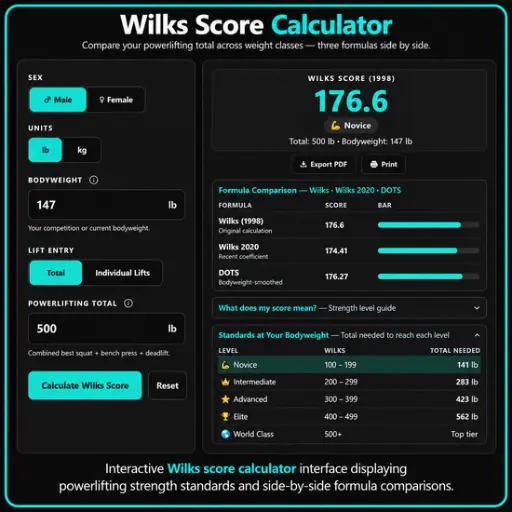
I stopped trusting raw totals after a 60 kg lifter and a 120 kg lifter both posted a 600 kg total and the room tried to call it a tie. A Wilks score fixes that argument because it is a bodyweight-adjusted score that converts your lifted total into a number that travels across classes. Lifters of different sizes can finally be compared fairly, and that cross-class comparison is what I reach for when I’m ranking a whole team instead of arguing lift by lift. Enter the best 1RM squat, bench press and deadlift you actually hit, have them summed, and the score reflects the full meet rather than one good day on one lift.
The idea came from Robert Wilks of Powerlifting Australia, and this tool does not force you to pick one era; it runs Wilks 2020 and DOTS alongside the original, all three from the same numbers. You just enter your gender, bodyweight and powerlifting total, press Calculate, and read them simultaneously instead of doing the maths by hand. You can work in kilograms or pounds too, something I appreciate when half my lifters log in one unit and half in the other, and the calculator handles the switch behind the scenes. And because all All Formulas 1RM calculations run in your browser with JavaScript, no data leaves for a server while you are checking scores between attempts.
Features at a Glance
| Feature | What it does |
|---|---|
| Three Formulas Side-by-Side | Computes Wilks (1998), Wilks 2020, and DOTS simultaneously, not choosing just one |
| Reps → 1RM Estimation | Enter a training set (weight × reps) per lift; 1RM estimated via the Epley formula |
| Personalized Strength Standards | Shows the exact total needed at your bodyweight to reach each level |
| Individual Lifts Mode | Enter squat, bench press, and deadlift separately; total is calculated automatically |
| lb / kg Switching | All inputs and results update instantly when you change units |
| Strength Level Badge | Wilks score mapped to a labelled level, Beginner through World Class |
| PDF Export | Generates a PDF report entirely in your browser, no upload, no server |
| Print View | Clean, ink-friendly print layout strips the calculator UI |
| Mobile-Friendly | Fully responsive across phones, tablets, and desktops |
| Accessible | Keyboard navigable, ARIA-labelled, visible focus indicators |
Start with just three inputs your gender, bodyweight, and total and all three scores appear instantly. Everything else builds from there: individual lift entry, rep-based estimation, and personalised targets.
How to Use the Wilks Score Calculator?
Go from an empty form to your final score in four simple steps — here is the complete walkthrough.
Step 1: Set Your Gender and Units
Begin by selecting Male or Female. The Wilks formula applies a distinct set of polynomial coefficients to each Gender, so this selection determines the exact coefficient set behind your score. Then choose your unit lb or kg. Every input and output converts instantly on toggle, so nothing needs re-entering or recalculating.
Step 2: Enter Your Bodyweight
Enter your bodyweight in the selected unit; for competition purposes, use your official weighed-in figure. The calculator enforces the validated ranges 40 to 210 kg for men, 26.51 to 150.95 kg for women because the coefficients were derived from data within these bounds and lose reliability outside them.
Step 3: Enter Your Powerlifting Total
Choose the entry mode that matches the data you have. Enter your total directly, or switch to Individual Lifts mode and input your best squat, bench press, and deadlift the calculator sums the three lifts into your total automatically.
Step 4: Press Calculate and Read Your Results
Hit Calculate Wilks Score, or simply press Enter in any field. Your Wilks (1998) score appears with its strength-level badge, all three formulas Wilks 1998, Wilks 2020, and DOTS display side by side for direct comparison, and the Personalized Standards accordion reveals the precise total required at your exact bodyweight for every strength level.
What is a Wilks score?
The Problem with Raw Powerlifting Totals
A 600 kg total tells two different stories depending on who lifted it. For a 60 kg lifter it is extraordinary; for a 120 kg lifter it is strong but expected because heavier athletes carry a structural advantage in absolute load capacity. Raw totals are perfectly fair inside a weight class, but the moment you compare across classes, across sexes, or across your own changing bodyweight, they stop meaning the same thing. That is where a bodyweight-adjusted score earns its place: measuring yourself against lifters in other classes, tracking progress through a bulk or a cut without the numbers lying to you, and judging year-on-year improvement independently of bodyweight fluctuations.
How the Wilks Formula Equalizes Strength
A Wilks score is your total in kilograms multiplied by a coefficient drawn from a 5th-degree polynomial fitted to real competition data score = total in kg × 600 ÷ P, with the polynomial fitted separately for men and women from gender-specific constants. Because the coefficient falls as bodyweight rises, a heavier lifter must total more to earn the same score as a lighter one; the formula is designed so that an identical score is, in theory, equally difficult to achieve at any bodyweight within the fitted range. In practice the equalization is imperfect, particularly at extreme bodyweights which is precisely why Wilks 2020 and DOTS came along later.
A Brief History: Robert Wilks and Powerlifting Australia
The formula was developed by Robert Wilks of Powerlifting Australia and published in 1998. It served as the IPF’s official scoring method for decades and remains the most widely cited bodyweight-adjusted strength score in powerlifting. In 2020 the IPF refreshed the coefficients against a larger dataset, producing Wilks 2020; DOTS arrived separately, built on a 4th-degree polynomial to answer lingering fairness concerns at extreme bodyweights. This calculator computes all three simultaneously from the same inputs.
The Three Formulas: Wilks, Wilks 2020, and DOTS
Wilks (1998): The Universal Reference
The original formula runs on a 5th-degree polynomial with Robert Wilks’ 1998 coefficients in plain terms, Score = 500 ÷ poly5(bodyweight in kg) × total in kg, where the 500 multiplier scales results into the familiar 0–500+ range. It remains the universal reference because decades of historical records were set against it, making it the right choice whenever you compare performances across eras. In this tool it sits beside the newer version, and the two are not interchangeable.
Wilks 2020: The Current IPF Standard
Wilks 2020 keeps the 5th-degree structure but refits the coefficients on a larger, more recent IPF dataset and rescales around a 600 numerator, which is why its scores land roughly 15–20% higher than the original. The difference is not just the numerator: the curve shape itself was redrawn to treat the very heavy ends differently, answering the main criticism of the old curve from my years around meets. In practice, Wilks 2020 scores lighter athletes slightly higher and heavier athletes slightly lower than the 1998 version. Always check the version before trusting a score a 90 kg man totalling 500 kg can read as 383.50 or 319.20 depending on the sheet, and the higher figure is not an error. For anyone competing under an IPF-affiliated federation, Wilks 2020 is the current official score.
DOTS: A Modern Alternative
DOTS takes a different mathematical route: a 4th-degree polynomial with coefficients derived from IPF data, credited to Brechue & Mayhew the name stands for Dynamic Old-Timers Score. It was built specifically to fix perceived fairness gaps at the lightest and heaviest ends of the spectrum, where the 5th-degree Wilks curve can reward extreme bodyweights disproportionately. Some federations use it as their primary scoring method, and many coaches prefer it for the most equitable comparison across the full bodyweight range. Like the two Wilks versions, it is a bodyweight-adjusted scoring formula but each was built on different datasets with different coefficients, so their separate curve fits were never meant to align.
Which Formula Should You Use?
Match the formula to the job. For historical comparison or general reference, use Wilks (1998) the most widely understood score with the longest record behind it, kept for old records reported alongside new figures. For IPF competition or current federation standards, use Wilks 2020, the active official method. For cross-class comparison at extreme bodyweights, use DOTS. If unsure, run all three and compare: a wide gap between them on the same input flags a bodyweight where the formulas genuinely diverge. One rule covers all of it check which formula a meet used, and never assume different numbers are a mistake. Their outputs live on different scales, they do not convert into one another, and a result from one system is simply not comparable with a result from the other, even on the same day.
A Worked Comparison: The Same Lifter, All Three Formulas
Take two lifters: a 90 kg man totalling 600 kg and a 120 kg man totalling 720 kg a much larger absolute load. On Wilks (1998) the two scores come out roughly level, the heavier lifter’s extra 120 kg buying him no advantage. On Wilks 2020 and DOTS, the 120 kg lifter scores lower, because both newer curves penalize heavier bodyweights slightly more. That is the equalization working exactly as designed and a live demonstration of why the version printed on the sheet matters.
| Lifter | Bodyweight | Total | Wilks 1998 | Wilks 2020 | DOTS |
|---|---|---|---|---|---|
| Male | 90 kg | 600 kg | ≈ 358 | ≈ 362 | ≈ 364 |
| Female | 60 kg | 380 kg | ≈ 432 | ≈ 438 | ≈ 441 |
| Male | 120 kg | 720 kg | ≈ 357 | ≈ 349 | ≈ 347 |
Wilks Strength Levels: Where Do You Stand?
I learned early as a coach that raw totals mislead the room the moment a 100 kg client and a 60 kg client post numbers from the same event the heavier lifter looks untouchable while the lighter one’s work goes unrecognized. The strength level badge fixes that: one bodyweight-adjusted number that lets a whole squad, across genders, sizes, and weight classes, be compared fairly on a single leaderboard. Treat every band below as a loose orientation, because there is no official cut-off waiting to certify you and never compare a Wilks 2020 figure against these bands without remembering the newer scale reads higher than the original
The Six Levels Explained
| Level | Wilks Range | What it represents |
|---|---|---|
| 🌱 Beginner | 0-99 | Building movement patterns and base strength, just starting the barbell journey |
| 💪 Novice | 100-199 | Consistent training paying off; linear progression producing results |
| 🔥 Intermediate | 200-299 | Structured programming; stronger than the vast majority of gym-goers |
| ⭐ Advanced | 300-399 | Club-level competitive strength; regularly placing in local meets |
| 🏆 Elite | 400-499 | National-level competitor; among the top powerlifters in any country |
| 🌍 World Class | 500+ | International podium contender; world-record territory |
🌱 Beginner (0-99)
Most people who have never trained for strength land here, and that is exactly where they should be. The priority at this stage is consistent practice, sound movement quality, and steady linear load increases not chasing a Wilks number.
💪 Novice (100-199)
Roughly a dedicated gym-goer with 6–18 months of consistent barbell training, still adding weight every session or every week through linear progression. Reaching 200 is already a meaningful achievement for a recreational lifter; for a 90 kg male, a Novice score corresponds to roughly a 170 kg total.
🔥 Intermediate (200-299)
This is where simple linear progression stops working and structured periodisation takes over. An Intermediate Wilks sits significantly above average gym strength cross 300 and you are stronger than the vast majority of gym-goers and usually competitive at local club level, where most recreational powerlifters compete.
⭐ Advanced (300-399)
Club and local meet level. Reaching Advanced typically demands 2–4 years of serious, structured strength training for a 90 kg male, roughly a 500–665 kg total. Lifters here are competitive locally and knocking on the door of bigger stages.
🏆 Elite (400-499)
National-level competition territory. Past 400 the label changes: Elite lifters are typically ranked in national competition and have been competing for several years. Training at this level is highly specialised and usually coach-guided.
🌍 World Class (500+)
World records and top international performances a handful of lifters per weight class worldwide operate here. The score has no upper bound; world-record performances exceed 500 and can push past 600.
Using Your Wilks Level for Goal Setting
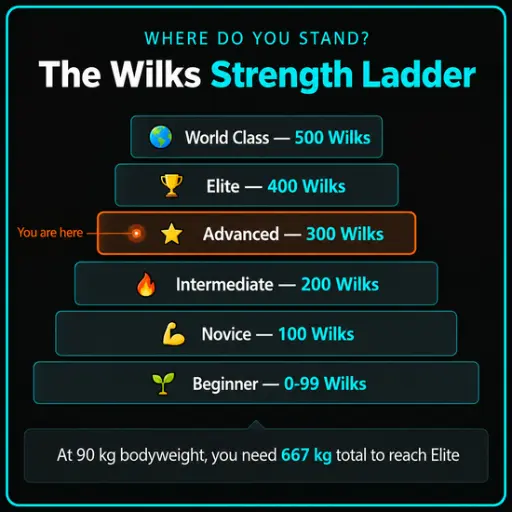
I start goal-setting backwards, because the reverse Wilks calculation answers the most practical question a lifter actually asks: what minimum total, at my exact bodyweight, reaches the next level? The badge is only a current snapshot the Personalized Strength Standards table reverses the formula for you, so its target total updates whenever a bodyweight change shifts you into a different band. When reading the table, find your current level first: the arrow marks it, with levels already passed dimmed behind you. Then look at Total Needed the additional kilograms required to enter the band above you. Take the built-in example: a 90 kg male sitting on a Wilks score of 350 sees 667 kg needed to reach Elite (400). I like that honesty, because the gap stops being motivational fog and becomes a concrete programming target. Take the current total of 600 kg, divide the 67 kg shortfall across the three lifts while respecting your current ratios instead of forcing equal jumps everywhere, and you have specific lift-level targets to train toward rather than one abstract number to worry about.
Personalized Strength Standards: What Do You Need to Level Up?
How the Calculator Finds Your Target Total?
This section explains the Standards at Your Bodyweight accordion the reverse Wilks calculation that answers the most practical question a lifter can ask: how much do I need to total to reach the next level? The formula runs the Wilks equation backwards: Target Total = Target Wilks Score ÷ wilksCoeff(bodyweight, gender). For each level threshold 100, 200, 300, 400, 500 the calculator solves this against your current bodyweight and sex, returning the minimum total in your chosen unit. In my coaching work I open this section first, because it frames the minimum total for your bodyweight and gender before ambition enters the conversation. The figure is bodyweight specific: if your bodyweight changes, the target moves with it.
Reading the Standards Table
Your current level is marked with a arrow, with levels already passed dimmed behind you. The Total Needed column shows the minimum total to enter each band; World Class reads “Top tier” because there is no upper bound. The result panel pairs that figure with a loose six-range level table a Strength Level Badge translating a raw score into plain orientation rather than a final verdict. I treat the whole display as a rough guide, especially when an athlete sits between bands: on the Wilks 2020 chart I read Intermediate as 350–459 and Advanced as 460–579, nothing more mystical than that, and Elite at 580 and up is only a coefficient-adjusted number so always name the version before trusting a 2020 equivalent someone quotes in the gym.
Planning Your Next Training Block From Your Standards
Take the Total Needed for your next level and divide it across the three lifts according to your current ratios. If your total is 600 kg say 240 squat, 160 bench, 200 deadlift and Elite demands 667 kg, the 67 kg shortfall distributed proportionally gives you specific lift-level targets instead of one abstract Wilks number. After the block, re-score and compare what actually changed before touching the next block of programming. That is also where this table earns its keep through bodyweight changes: year-on-year progress despite fluctuations, kept as a rough guide and never a promise.
Wilks Score in Competitive Powerlifting
How Federations Use Wilks Scores
Federations use the Wilks score in three ways: Best Lifter awards, comparing performances across weight classes at the same meet; federation rankings, ordering lifters nationally or internationally on a single scale; and historical comparisons, measuring current lifters against records from other eras or classes. Wilks 2020 is the current IPF official standard, while some federations still use the 1998 version or DOTS so when registering for a meet, check which formula applies.
On the platform, though, I trust a Wilks number only in sanctioned meets, where every lifter competes under the same rules, the same judging standards, and the same IPF technical rules. That trust comes from the attempt itself: a competition total only counts when it is judged to standard on depth, the pause, and lockout. Used as the current IPF competition standard, Wilks still works as a primary scoring method for active competitors and in practice I have seen it settle head-to-head battles inside a weight class and settle arguments across other weight classes, which is exactly where cross-class comparison earns its keep
Comparing Across Gender and Weight Classes
A key use of the Wilks score is head-to-head comparison of male and female lifters something raw totals cannot do. Because the polynomial coefficients are Gender-specific, a Wilks score of 400 represents an equally difficult achievement for a male 90 kg lifter and a female 63 kg lifter, relative to their respective population distributions.
The limitation is worth knowing: the score reflects population averages, not a perfect equaliser. Some lifters are more or less “efficient” for their bodyweight than the polynomial assumes and the cracks show widest when comparing across federations, because different equipment rules break the consistent conditions the formula assumes before any score is compared. At national-level competition, a lifter is ranked against national fields and, rarely, alongside world records not against a gym leaderboard built on looser calls. The meet data tells the real story: national-level raw competitors typically sit between 350 and 500, with world-class figures above the noise most club lifters argue about. That is why I use Wilks for comparisons and honest benchmarking while remembering it is not a federation ranking system and why historical comparison across eras works when you compare performance rather than chase a perfect equaliser.
Export, Print, and Share Your Results
Export to PDF
Clicking Export PDF generates the file entirely in your browser no server, no upload, no data leaving your device. In my coaching work, the export I trust most is the one that never leaves the room: the computation happens locally, with no account required, so a lifter’s meet inputs stay on the device and no file is held remotely. The file, saved as wilks-score.pdf, includes your inputs (sex, bodyweight, total, and entry method), your Wilks 1998 score and strength level, a comparison table with all three formula scores, and a disclaimer noting the results are estimates. I tell lifters to keep the printed copy checkable, because the maths behind the score stays visible and anyone reviewing it can see how the formula runs. Useful for sharing with a coach, keeping a training log, or benchmarking before a competition and when you compare that export against one from an older calculator, always check which version produced it, or two honest exports will look like a mistake.
Print Your Results
Clicking Print opens the browser’s print dialog with a dedicated print stylesheet a clean, ink-friendly, black-and-white summary. “Save as PDF” in any browser works as an alternative to the Export button. In practice, printing works best as a private benchmark you can hand straight to a coach or pin up for yourself: clean enough to read at a glance between sets, whether it goes on a physical training board or into a coach’s hand.
Share the page, not just the headline number include your bodyweight, gender, and lifted total, and whether you entered them in kilograms or pounds, so the reader sees the score in context. One warning I repeat in the gym: these numbers do not translate across scoring systems, so never pass a Wilks sheet off as a DOTS or IPF GL result. Finally, file the sheet where you will actually find it again alongside your competition data rather than buried in downloads and re-export after every block, so your tracking shows change, not a single lucky day.
Technical Notes and Input Validation
Calculation Engine
All computation runs client-side in JavaScript no data is sent to any server. The engine is deterministic: identical inputs always return identical scores. In practice I test that by entering the same total in kilos and then again with the pound toggle, because the score should come out identically either way. Scores are rounded to two decimal places, pressing Enter in any input field triggers the calculation, and pressing Escape closes any open tooltip.
Two honest limits ship with the engine. It does not adjust for age, training experience, limb lengths, or leverages it adjusts for gender only, so there is deliberately no age adjustment hiding behind the result. And it does not convert between Wilks, DOTS, and IPF GL Points, because they are separate fits: labelling the result with its primary score version matters most when you compare it against earlier versions. Finally, reliability decreases above 10 reps so if an estimate is driving a meet plan, verify it with a direct test rather than trusting the back-calculation.
Input Validation Rules
The calculator rejects inputs outside the polynomial’s validated range, because extrapolating beyond these bounds produces unrealistic scores. The fit is tightest inside typical competitive bodyweight ranges I take extra care with lifters far outside that band, or with gym maxes that were never judged to depth or pause. Every formula set on this page is an attempt at a problem with no exact answer: muscle force follows cross-sectional area, not volume, so as body mass rises a simple proportion quietly breaks down in real lifters, and a plain ratio ends up favouring lighter lifters. That is why a fitted exponent matters and why three different curve fits can disagree without any of them being broken.
| Input | Valid Range | Notes |
|---|---|---|
| Bodyweight—Male | 40-210 kg (88.2-463 lb) | Reflects the range over which Wilks coefficients were fitted |
| Bodyweight—Female | 26.51-150.95 kg (58.4-332.6 lb) | Same reason, coefficients aren’t reliable outside this range. |
| Total | > 0 kg; max 2,000 kg (4,409 lb) | Sanity cap; any total above this flags an input error. |
| Near-edge warning | Within 5% of the boundary | Results may be less accurate near formula extremes. |
Coefficient Sources
| Formula | Polynomial degree | Source |
|---|---|---|
| Wilks 1998 | 5th-degree | R. Wilks, Powerlifting Australia (1998) |
| Wilks 2020 | 5th-degree | Revised IPF dataset (2020) |
| DOTS | 4th-degree | IPF-derived, Brechue & Mayhew |